Marty (1955)
Published:
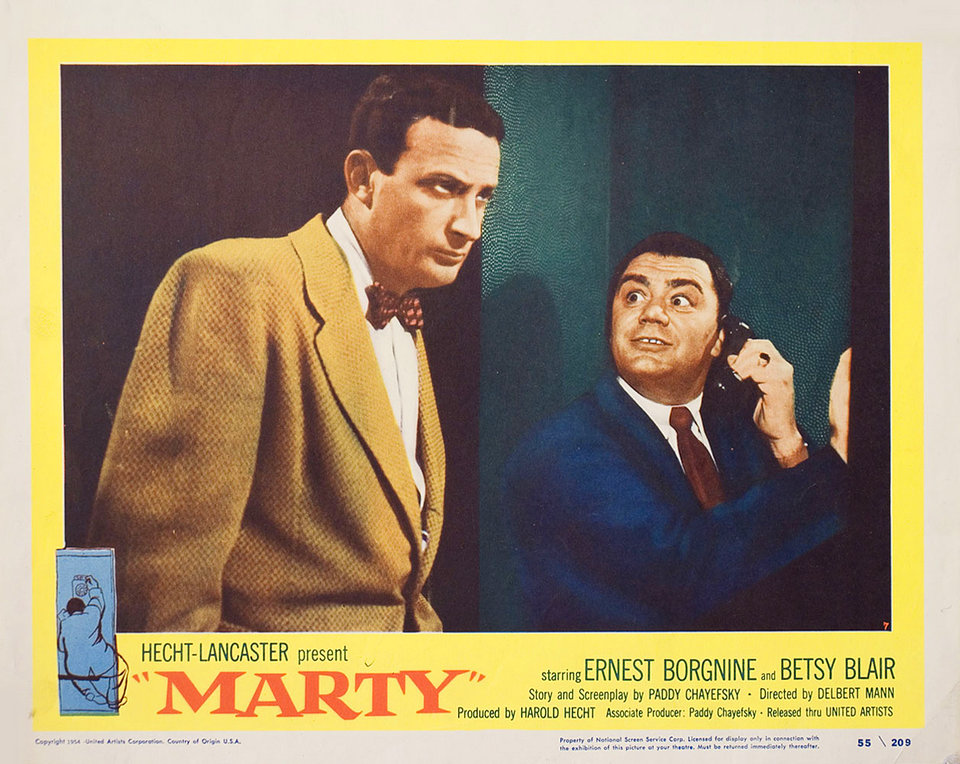
Marty (1955) is categorised as a "romantic drama" film. I do not necessarily disagree, but I think the film may also be viewed another way.
Marty tackles the exact same subject as Michel Houllebecq's Extension du domain de la lutte did fifty years later ie, the life of men who are unable to find a wife. The way the issue is presented in Marty is presented in a way that was acceptable for people in United States in 1950s, which means it is drastically different to either Houellebecq's book or the book's 1999 film version. There is much less violence and pornography. But everything else is still there.
What connects the two is the mixture of despair, apathy, and resignation. Marty, the protagonist from 1955, is an American butcher of Italian descent who lives with his mother and spends his free time hanging out at a pub with his buddies, or at home; the unnamed protagonist from 1994 is a French software engineer who lives alone and spends his free time watching porn, smoking cigarettes, and drinking alcohol. They seem to be a world apart, and yet... they could well be the very same person, because under the outer layer of different jobs, names, time periods, and places they share the same struggle, and they respond to the struggle in the same way.
They are both without a woman in their life. They may interact with women in their life (Marty has customers, his mother, etc; Houellebecq's hero has his coworkers and prostitutes), but neither of them has a stable relationship. They both react with the same, sometimes violent, apathy to this sorry state of affairs.
There are several similarities between Marty and Whatever.
Two men who could have lived
In Whatever, it is the unnamed narrator and his colleague Tisserand; in Marty, it is the titular character and his best friend Angie. However, one could reasonably argue that the roles of the characters are mixed, and not map cleanly between the two stories.
One character is nihilistic and resigned, and drowns his his loneliness in intoxication and meaningless sex. In Whatever this character is the unnamed narrator; in Marty it is Angie, Marty's friend. While never explicitly stated in the 1950s film, it is clear what Angie's frequent allusions to "visting the 72nd street" imply.
The unnamed narrator hands Tisserand a knife and pushes him to murder two young people having sex on the beach after a New Year's party, after Tisserand has had a miserable night of rejection and dissapointment. Angie tries to convince Marty that Clara (the woman whom Marty has met a dance) is an ugly "dog", and wants to make him ditch her. Murder and calling someone ugly are two very different things, but here they can be taken symbolically: they both are attempts to make the character give in to anger, to throw away their chance at happiness, to make them incapable of love. It is just that Hay's era Hollywood would not dare show outright murder, so the director of Marty had to use different, less literal, tools to paint the picture.
In contrast to Angie and the narrator, both Marty and Tisserand still have some hope. It is clear in Tisserand's admission that he can "afford a prostitute a week", but wants to keep trying to find real love; and Marty's final rejection of his friends' calls to ditch Clara.
The women who could have loved
Another connection between the two stories are the women representing the love interest. In Whatever it is only a possible, and discarded, love interest, but the similarities are still striking to me.
Clara, the woman Marty meets, is a high school chemistry teacher described as plain and not particularly attractive. Catherine, the woman with whom the unnamed narrator considers having regular encounters with, is a programmer at one of the French ministries, and also described as not attractive. Both women are also shown to be passionate about their respective jobs, and to have the willingness and drive to grow in them.
Here is where the two stories differ the most. Marty shows the protagonist as rejecting the apathy and embracing love. Houellebecq does not give the same grace to the unnamed narrator, who instead discards the love interest, and (the way I read the story) ends up attempting suicide. In neither case, however, is the result shown, as the last scene is cut just short of the final answer, denying us a clear closure. Did Clara agree to see Marty again after he broke his promise to her in his moment of weakness? Did the narrator kill himself, or recover from depression? We do not know, as both stories end by only suggesting the resolution and letting the viewer or the reader interpret it their own way. (The 1999 version of Extension du domain suggests an obvious happy ending and reversal of fortune, and ends on a much more optimistic note than the book version.)
I do not know if there is a conclusion to this post. Which, now that I think about it, is quite fitting if the subject matter are stories without a clear ending, and one that is wide open to wildly different interpretations.
Maybe Marty was rejected by Clara, and ended up dying alone. Maybe Houllebecq's narrator ended up recovering and proposing to Catherine. Maybe they both killed themselves. Maybe they both lived happily ever after.
Maybe they are there to teach us something. If so, what lesson is it supposed to be?
Maybe the stories are there to show us that some things do not change, and being rejected, miserable, and alone is just part and parcel of some people's lives.
I do not know.
What I do know is that they show that there are different paths we can take, even if we start from the same point; different resolutions, even if we begin in the same situation. At one point or another we are the Marty, the Clara, the Angie, the unnamed narrator, and the Tisserand, and the Catherine. We may not be at fault for the situation we find ourselves in, but we are responsible for how we handle it.
I do not purport to give advice on how to live life, as I am only barely competent enough to guide myself through it. But, if I may be allowed to bold enough to suggest something anwyay, let me say two things.
First, err on the side of calling Clara.
And second, while you are at it, keep your promises and do it on time.