A concerning lack of vitality of VitalSource ebooks
Published:

VitalSource ebooks are anything but. Regrettably, this means that Routlege's ebook catalogue is almost useless.
I found an interesting book: Reverse Design Final Fantasy VII. It is available from the publisher's website as a paperback, a hardcover, or an ebook. Having been burnt by DRM-encumbered ebooks before I decided to learn more about what is meant by "purchase eBook".
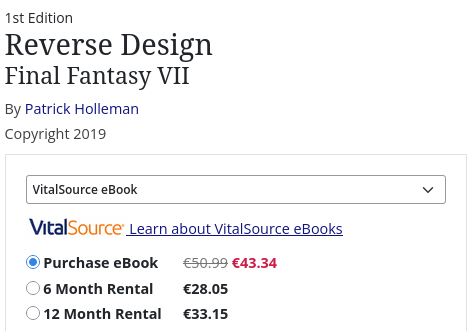
You may expect the phrase to carry the commonly accepted meaning ie, that you are buying an ebook. However, VitalSource (or maybe Routlege) is trying to pull a fast one here, because you would not, in fact, be "purchasing" in any reasonable sense of the word. If you click the Learn about VitalSource eBooks link, you will be able to learn about the scale of the fuckery that is happening here.
Below I provide several excerpts from the "eBook FAQs" on Routlege's website. In my opinion, every excerpt makes the situation worse than the previous one.
Not a "purchase" in any reasonable sense
At least not a purchase of an "ebook".
After completing your eBook rental or purchase on Routledge.com, you will receive a confirmation email with an access code that gives you admission to your eBook via VitalSource's Bookshelf. You'll then create an account in the Bookshelf app.
Once you've logged in, click on the Tools menu near the top right of the screen and select Redeem Codes. Next, enter the access code from your confirmation email and click Redeem. The book will now be available to read.
This, to me, implies that what is actually being sold by Routlege is not an ebook at all; the object being sold is rather an access code that can be used on some app. Alarming questions immediately arise. What if:
- the app is not available on my system or stops working after an update?
- I lose my login credentials to the app?
- the phone on which I had the installed gets stolen?
- the company operating the app gets hit by ransomware, and loses the database recording my access to the file?
All these potential issues would be trivially prevented if the ebook was a real purchase, and I could just download an epub of a PDF.
Downloads and offline reading
Fortunately, the FAQ contains some information about downloads and offline access to the "purchased" ebooks.
Yes, users who download the Bookshelf app on their devices can read their eBooks offline.
This is a completely useless non-solution to the question. Since the "ebook" cannot be opened without the Bookshelf app, I do not see how it can be called "downloaded" in good faith - "cached in the Bookshelf's storage" would be more honest. Without any adjectives, downloading implies copying the information into permanent storage freely accessible by the user; caching implies the copied data is ephemeral and may disappear at any time.
A very short perpetuity
The very next item in the FAQ page offers some insight into the longevity of the "purchase" that can be cached in the app.
Routledge.com provides eBooks via VitalSource, which offers lifetime access to your eBook. Beginning June 15th, 2021, books with a perpetual eBook license will have five years of online access. During this time, you will have unlimited access to your book through Bookshelf online. However, this may change after the online perpetual license has expired. Any direct downloads you’ve made throughout that time to your device via the Bookshelf app will still be available, even after the online perpetual license has expired. More information on lifetime access.
Pardon my French, but this is a load of pure fucking bullshit with a side dish of bovine crap and a generous serving of cattle excrement for dessert.
I do not think companies should be able to hide behind EULAs, Terms and Conditions, etc in which they have redefined common words. "Lifetime access to your ebook" should mean "from the moment of purchase until your death", and "perpetual" should mean "for ever". I could maybe understand treating "perpetual" as meaning for the next 100 years, but definitely not as the next five years.
I understand that companies do not want to provide services in perpetuity for a fixed fee, and I think it is a completely reasonable stance. The problem that Routlege tries to escape by redefining what "perpetual" means and all the other shenanigans is, however, self-inflicted and could, again, be trivially solved by just letting people download a PDF or an epub.
Customer disservice
I think I am not the only one who balked at everything that the FAQ showed so far, and thought that maybe I can just email customer service and get a normal version of the ebook I supposedly have purchased, because the following FAQ item exists:
We do not email PDF files to customers due to our commitment to safeguarding our authors’ content against piracy. PDF files sent outside of an eBook reader can be shared, copied, and stored, which means they do not protect the work or intellectual property of our expert authors, contributors, editors, and reviewers. We value the work our community produces and only offer eBooks on Routledge.com via VitalSource’s Bookshelf eReader.
After stripping the corporate babble, the above excerpt compresses to basically this: to prevent an imagined problem (piracy) we render our product (ebooks) nigh unusable by wrapping it in DRM.
This brings us, in the end, to the source of all this ridiculousness: the irrational fear of piracy. The publisher appears to be scared shitless of an imagined armada of digital pirates, just waiting to ambush a ship full of precious ebooks, and it tries to protect itself by making the ebooks as cumbersome to read as possible. The irony is, that by making its product worse than the pirate's offering, the publisher condemns itself to the fate it so wanted to prevent...
It seems that very few companies ever realise the truth of what Gabe Newell said in 2011:
We think there is a fundamental misconception about piracy. Piracy is almost always a service problem and not a pricing problem. If a pirate offers a product anywhere in the world, 24 x 7, purchasable from the convenience of your personal computer, and the legal provider says the product is region-locked, will come to your country 3 months after the US release, and can only be purchased at a brick and mortar store, then the pirate’s service is more valuable.
There are a few exceptions eg, GOG, Bandcamp, Qobuz, or DriveThruRPG, that took Mr Newell's advice to heart and are not hostile to their customers. I am disappointed to see that Routlege is not one of them.
Further considerations
hosts a PDF of an interesting study conducted Back in 2015 the European Union conducted a study titled "Estimating displacement rates of copyrighted content in the EU". A PDF with the final report can be downloaded from the EU's own website, from netzpolitik.org, and I also host a mirror. Below is an excerpt from the "Main conclusions" section (emphasis mine):
In 2014, on average 51 per cent of the adults and 72 per cent of the minors in the EU have illegally downloaded or streamed any form of creative content, with higher piracy rates in Poland and Spain than in the other four countries of this study. In general, the results do not show robust statistical evidence of displacement of sales by online copyright infringements.
So, if the risk of online piracy is overblown, why are the publishers engaging in consumer-hostile behaviour?
With DRM on Routlege ebooks being so ridiculous, one cannot but think of The Right to Read, a short story by Richard Stallman. We may not be there yet, but the publishers and DRM providers are probably salivating at the idea we of bringin us into the future described in the story. As usual, Stallman Was Right.