Hang 'em High (1968)
Published:
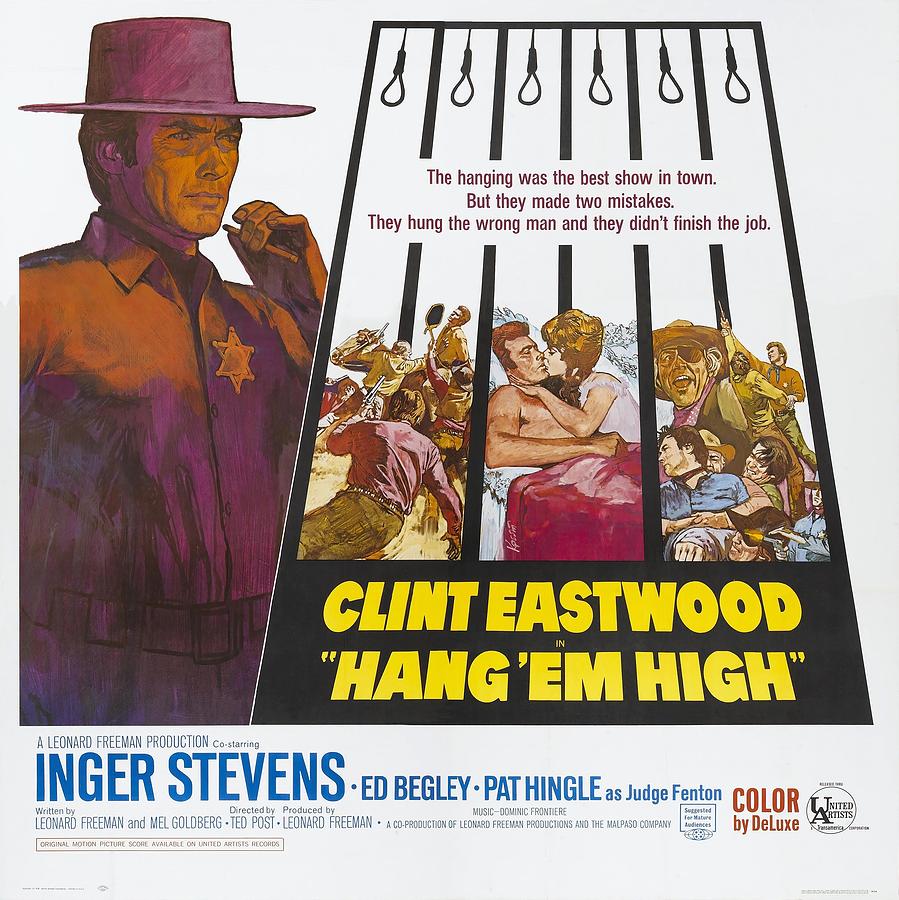
Clint Eastwood plays Clint Eastwood in an old Western film about a man on a quest for revenge.
The main plot point is strikingly similar to another film I have discussed on this blog ie, Fury from 1936: an innocent man is lynched, and wants to exact revenge on the people who wronged him, while being disgusted by the ordinary people who let their lust for blood override their sense of justice.
The question is, however, do people actually want justice?
In Hang 'em High, the judge, played by Pat Hingle, says that true justice is subordinate to the appearance of justice when Clint Eastwood's character, Jed Cooper, objects to two young men being charged with murder they did not commit. Unfortunately for them, the story of three murderers having been brought in by a marhsall has already spread and amending it now would make it look like there is no justice in Fort Grant.
The young men are hanged while Cooper attempts to use a woman's gentle embrace, to use a polite phrase, as balm to soothe his conscience.
The story is painted in clearly contrasting colours: it is clear who is in the right, who is in the wrong, and who struggles occupying the morally uncertain middle ground.
One other similarity with Fury is that there is a woman, a love interest of the male main character, who tries to stop the man from completing his vendetta. The interesting, for me, part are the differences in how it is handled by Fury, filmed in 1936, and Hang 'em High, filmed in 1968.
In the late 1930s, the lesson could not have been anything other than "the law must prevail" and "forgive thy neighbour". By the late 1960s, if we are judging by the films, the view shifted. The law initially fails Cooper, and he shows his exasperation when the judge gives him $11.40 that were taken from him by the mob, and considers the case closed. However, the story does not end there.
The first difference: the character gets the chance to get justice without having to forgo lawful means. Cooper gets hired by the judge as a deputy marshall, and is given the freedom to pursue his revenge as long as he stays within the boundaries of the law.
The second difference: the woman is not portrayed as rejecting the man when he does not immediately abandon his quest after she tells him to forgive his would-be murderers. She still asks him to let it go, but when he tells her that he wants to see it through, because he does have a realistic chance of accomplishing his goal, she does not start treating him as a monster.
Granted, the film does not show Cooper and the widow, played by Inger Stevens, together after they have their "let go" talk, but neither does it show Cooper as a bloodthirsty vigilante monster.
Overall, I think it is a film worth watching.