Design of Ozro: the core mechanic
Published:
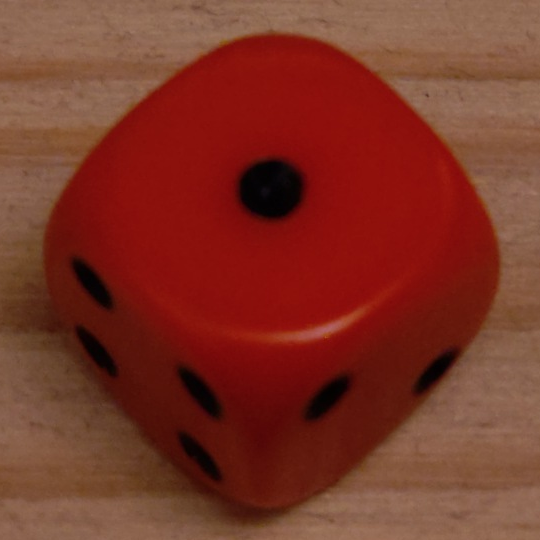
Ozro is a fantasy role-playing game, and at its core sits an outcome-resolution mechanic built around dice pools.
The design statement
Let me open with an excerpt from Ozro core rulebook:
The core of the rules is the success-counting dice pool-based skill system. It is designed to allow unlimited progression without artificial limits, but also without runaway power growth. If a player decides they want their character to become a true master in a skill it is possible, but will require dedication, time, and plenty of experience.
Progression yields diminishing returns, but having a bigger dice pool is always advantageous. It gives the players a tactile reward—they can see their dice pools, representing the power of their character, grow in front of their eyes—and can lead to spectacular results, or be the difference between the life and death of a character.
Ozro is not supposed to be a game of shared storytelling where everything is possible through the power of bullshitting the game master, but a game of a power fantasy, where a group of adventure seekers, a squad of mercenaries, or a band of brigands decide to take on the world and see how it plays out.
A power fantasy needs a way to represent that power somehow, its size, growth, ebb, and flow, and the most direct way is through numbers. Warhammer and other D100 systems use target numbers creeping ever closer to 100; Dungeons and Dragons and its D20 derivatives use bonuses creeping ever higher.
The problem with fixed-number systems
The problem with both, from my point of view, is that the numbers are inelastic and limited, therefore putting a hard cap on how much power can the player characters reasonably accumulate. Both systems have another weakness too; if taken to their logical conclusion, they have a point where the game loses all risk: where the target roll-under number reaches 100 in D100 games, and when the bonus reaches +20 in D20 games. Failure becomes virtually impossible, and success assured.
How are you supposed to give players the illusion of unlimited growth in power if the core mechanic of the system imposes one?
You can give players more variety and let them progress on more than one axis. For example, melee fighters can use more weapons and execute more attacks, while magic users can access more spells and cast them more frequently.
However, this requires going beyond the core mechanic and adding new rules to the system, making everything more complicated. I have been there, I saw where this leads to, and I decided I wanted off that crazy train of ever-increasing number of complications; Game Masters already have enough things to worry about as it is.
The advantage of dice-pool systems
There is a specific type of outcome-resolution mechanic that has my desired qualities ie, allowing for unlimited improvement without runaway power growth. There are games using this mechanic on the market already eg, Shadowrun.
This mechanic is the humble success-counted dice pool.
The mathematics of success counting naturally create diminishing returns for every die added to a pool, and yet, every such die brings some value to the pool. This is a perfect match for what I wanted to achieve with Ozro.
The design history
Being inspired by Shadowrun, the first step I took was to design the system around D6s and 5-6 as success markers. This is simple enough: more dice is better, bigger numbers are better.
However, my other big inspiration was the 2004 role-playing video game Fable. In Fable, you play the archetypical Hero, and your prowess is represented on three axes: Strength, Guile, and Will. I wanted this differentiation into the archetype of Warrior, Rogue, and Wizard to be present in Ozro too.
The easiest way to do it would be to either grant the Warrior players more Strength dice, the Rogue players more Guile dice, and the Wizard players more Will dice during character creation. However, this is not a real advantage, because nothing stops a Wizard player from improving their Strength pool and erasing the advantage.
The second easiest way to do it would be to grant the Warrior players more dice to the Strength rolls, the Rogue players more dice to the Guile rolls, and the Wizard players to the Will rolls. For example, the Warrior rolls three dice more than they normally would be allowed to whenever the Game Master calls for a Strength roll. However, at higher skill levels (if we take skill level as the number of dice rolled) the advantage would be minuscule, which is fine according to the "diminishing returns" design principle, but it is an artificial number, which runs counter to the "without artificial limits" principle.
The next few developments happened in relatively quick succession, and settled the core mechanic.
Differentiation with cardinality
I had plenty of dice of different sizes ("cardinalities" is the fancy word to use here, as it describes the "number of elements" in a set, and a die is a set of faces), and this gave me the idea to of using them.
I used D6s, D8s, and D10s This choice, slightly expanded with D12s, remains in the game until today.
This, however, immediately caused a problem: a success on a roll of 5-6 is fine for a D6, but is unintuitive for a D8 or a D12, so I decided to move the successes to the "highest two numbers".
Again, it becomes immediately clear that something is not right here. If a "success" means rolling on of the two faces, then a bigger-better die with higher cardinality actually has a lower chance of success. So I thought I should define success as 5+ ie, 5-6 for D6s, 5-8 for D8s, 5-10 for D10s. Frankly, it was a shit idea, because it meant players had to hunt for different numbers in potentially sizeable pools, which would be error-prone and time-consuming. It was also shit for another reason: the probability of scoring a success was terribly out of whack between different cardinalities, which was caused by my insistence on keeping some semblance of uniformity ie, scoring a success on 5+ for any die.
The next idea I had was to move the successful numbers to the other side ie, make success be 1-2 for a D6, 1-3 for a D8, and 1-4 for a D10. This lowered the difference between different types of dice, but was still not as elegant as it could be: players had to look for different things, and the numbers were kind of artificial.
Then, I got an idea that made everything beautiful: smaller dice should be better dice, and a success should always be scored on a roll of either a 1 or a 2.
Smaller is better
Flipping the bigger-better assumption on its head allowed me to make the system elegant.
No matter how many dice the players rolled, how many cardinalities the dice had, and what archetype of a Hero their character embodied, the players would only ever need to hunt for 1s and 2s.
Also, in exchange for a D6 with 1⁄3 chance of success, D8 with 3⁄8 chance, and a D10 with 2⁄5 chance, the new assumption gave me a D6 with 1⁄3, D8 with 1⁄4, D10 with 1⁄5, and D12 with 1⁄6. So instead of weird, disconnected fractions, the mechanic was now underpinned by a set of 1-nth fractions with denominators being subsequent integers.
The mechanical design was settled. What I did not realise at the time is exactly how powerful it would turn out to be, and how much influence on my way of designing and running games it will have.
The design itself
The final design of the outcome-resolution mechanic is straightforward:
- assemble a pool of dice
- roll the pool
- count successes
- if the success count is lower than the target number, you fail; otherwise, you succeed
The complexity and depth lie mostly in the first step.
The base pool is predetermined by the characters' Attributes, which determine the cardinality of dice in the pool, and the Skills, which determine the number of dice in the pool. However, the players can also decide to add extra dice to the pool from other sources eg,
- spend durability of their weapons to add dice to offensive rolls
- spend durability of their armour to add dice to defensive rolls
- drink alcohol to add dice to their social-skill rolls
- use first-aid kits to add dice to medical assistance rolls
- buy better maps to add dice to their navigation rolls
It does not matter how many dice and how many sources of dice the player adds, they only need to count 1s and 2s after a roll. This means that a player can build a pool with D6s from their character's Attribute, D8s from equipment, and some D12s from a nearly-expired potion they bought three months ago, and it all works out.
Attributes
There are several Attributes in the game, each representing some particular aspect of what can be achieved in the game: Strength, Endurance, Dexterity, Coordination, Will, Awareness, and Cunning. During character creation, each Attribute is assigned a rating from pefect meaning D6, good meaning D8, mediocre meaning D10, and poor meaning D12. For example, a character with perfect Strength rating rolls D6s for all skills depending on Strength.
On average, a character has 1 perfect, 3 good, 2 mediocre, and 1 poor Attribute. If such a thing existed, the average die a player would roll for their character's attributes would be a D8.9 according to this distribution of Attribute ratings.
The typical Hero and the average Attribute
The idea of a "typical Hero", or rather a typical adventurer, but a hero is easier to write, stems from the above average Attribute rating. A typical hero's average attribute adds D9s to the pool, and if we take a high-flying eagle's point of view and look over the wide horizon of all games that had been played, are played, and will be played... we realise that the average is what counts.
Therefore, in many places, a D9 with roughly 22% chance of scoring a success may be assumed to be rolled. From the game design point of view what counts is what happens over a thousand sessions, not what happened last night at Joe's table. Sure, Joe will never roll a D9 but a Thousand-Sessions Joe can be thought of as if he never rolls anything else. (Statistics and probabilities are weird.)
The boring game and the power fantasy
What I described here is the base system, the "boring version" of the game that the System Designer thinks about when creating rules, what the Adventure Writer uses when balancing adventures; the D9s and the typical heroes. What the Game Master plays when running the game at a table is a bit more interesting since he sees a session instead of a thousand sessions, but he still mostly uses the core, "boring" rules.
On the other hand, the Players are given ways of bending these rules by way of their characters' Archetypes' special Powers. This is how the power fantasy comes into life, not just from playing within the rules, gathering experience to improve skills, collecting gold to improve equipment, etc; but also from being able to step outside the rules in a particular area and do something that is normally not allowed. However, this is a topic for another post.