"The Importance of Terrain"
Published:
The Importance of Terrain is a short article by Stephen Radney-MacFarland about combat scenes in RPGs. It is neither an "instruction manual" nor a prescriptive article that you can use to build a scene; rather, it presents a couple neat ideas you can use to add some spice to your scenes.
Interesting terrain
That building combat scenes in "interesting" places is kind of obvious, but what makes a place interesting may not be intuitive. To be completely honest, you can never expect what players will find interesting.
I have once ran a combat scene set in a kobold cave, where the central feature was a big pile of rubbish giving off weird gasses, and surrounded by pools of suspicious liquids. The players had been sent on a quest to rescue some kidnapped children, and were chasing kobolds through the cave, when they entered the rubbish room. Kobolds ran into the pile, disappearing from players' sight, and (what the players did not know at the time) got out of the room through a hidden exit. The brave adventurers decided to look for kobolds in the pile, and as soon as they were on top of it, the scaly bastards set the whole thing on fire.
The players did not complain about being baited, or about being set on fire. They complained that the colour I used to paint the rubbish pile on the battle map was not the "proper colour for garbage"... I ran the adventure years ago, and yet I still remember this complaint.
What I wanted to say, I think, is that you never know what seemingly mundane or inconsequential detail the players will focus on. In my experience, as long as you have one or two terrain features that stand out (eg, a literal pile of burning garbage) and can play some role in the scene (eg, trapping the players), you are good to go. Most players will be perfectly happy with such a scene, and do not need a gourmet, bespoke set design for every combat.
The layout recipe
The article mentions that combat scenes in D&D 4e have more monsters than previous editions (minions say hello), and that actors in the scene are more mobile. I think this is part of the reason why the article puts such emphasis on dividing the ground. To quote:
Larger spaces with interesting terrain that both the PCs and their enemies can take advantage of — or be foiled by — is infinitely more fun than a small and relatively empty room that constrains combatant choice to a small set of dreary moves.
But here's the rub — large areas of interconnecting chambers, complete with alcoves, galleries, and antechambers, are far more exciting than just plopping down a 10 by 8 tile and sprinkling it with rubble. Creating a network of interconnected areas creates numerous avenues of conflict and creates the possibilities for a series of evolving fronts that metamorphoses same-old encounters into tactical puzzles that'll sing like legend to a gaming group.
Why is it part of the reason? Look at what happens when your assumed monster-to-character ratio is more than 1:1. If you a playing with a typical three- or four-player group and the ratio is 2:1 suddenly you have between a nine and a dozen actors in the scene; increase the ratio to 3:1 and you have between a twelve and sixteen actors. Having them all in a big clump in the middle of the hex board is, pardon my French, unwieldy as fuck (although there are ways to alleviate this), so splitting the combat into two or three smaller skirmishes makes sense. It makes for a more complicated design, and you need to think more when running such a scene, but it works.
However, on account of not being paid to write adventures and running games, I stand firmly on the side of "good enough"; "incredible" is nice every once in a while, but I count on the "incredible" emerging from the interaction between the game as I am running it and the players. Let the players share the responsibility for the game being fun, instead of putting it squarely on the game master's shoulders.
YOU ARE HERE
Having a piece of terrain that stands out signals something to players ie, you are here, in a scene of this particular type. It lets the players anticipate and plan; and it saves you, the game master, some work, because you can rely on tropes.
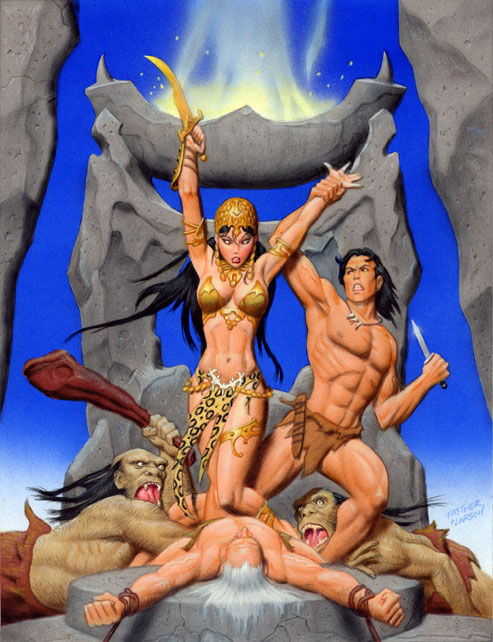
Look at the cover image for this post, that I took from the gallery page of Messrs Fastner & Larson:
It is a simple scene. There is a stone altar to which an old man is tied, there is a priestess, there are some ogres, there is a glowing magical something in the background. Take the man trying to stop the priestess (or is she an evil warlock?) as the role the players will fill in your adventure, and suddenly the picture becomes an almost ready-made combat scene! All that was needed were two interesting pieces of terrain:
- the central altar
- the surrounding stone pillars, one with glowing magic on top
The questions almost ask themselves: is the sacrifice powering the magical glow? is the woman a priestess trying to kill the evil shaman, or is she a warlock trying to take possession of a holy site protected by a druid? are the ogres on her, or his side? can the players climb on the pillars? can they fall from them? where is the altar: on a hill, on a plain, in a forest, or in a valley?
Stereotyped scenes
So, one piece of advice I fully agreed with was this:
A canny eye toward terrain set up can also help you communicate story elements to your players quickly and without the need to say a single word. Just put down some sarcophagi, and the players will know it's a crypt. Put down an altar, and you've just communicated that it's a temple. Put down piles and piles of bones in front of a yawning cavern, and the players will know their characters are likely in a world of trouble…
Stereotyping scenes may seem lazy, but I think it is a useful tool in a game master's bag of tricks.
A room with a sarcofagus, is not just a room with a sarcofagus. The sarcofagus is there for a reason, and from this reason you can spin the whole story of the room. It is exactly like looking at an old-school fantasy illustration, and getting a story out of it.
Let's engage in a little exercise. Assume there is a sarcofagus in the centre of the room. What now?
If the sarcofagus is in the centre, it means it is a tomb of someone important ergo, it is a mummy. If there is a mummy, it means the players will have to deal with sorcery. If the buried person was important they probably had slaves or servants, so there will be minions. How are the servants supposed to appear in the scene? Let's make their skeletons sit near the walls, or make them statues surrounding and guarding the sarcofagus. Also, if the buried person was important, there must be some treasure around; if not in this room, then in the next one, and if there is no other door than the one the players entered the room through, there is probably a hidden one... and hidden doors mean there may also be hidden traps in the room.
Is it a stereotype pulled straight out of a pulp sword-and-sorcery novel? Well, yes.
Is it fun to play? Also, yes.
Terrain and props are important, but you do not need all of them all the time to have a perfectly fine, good enough game. Put one or two interesting things in a room, and spin the rest out of them — just ask yourself the questions "what would I usually find in a room with this thing?" and "what monsters would be there?" Or work in reverse, and if you have such-and-such monsters in a scene, ask yourself "what would the monsters gather around?" and presto, you have your central piece.
Afterword
While short, the article shows the amount of thought and planning that went into the 4th edition of Dungeons and Dragons. I am still amazed that it was abandoned and almost erased from history, and replaced with the steaming pile of rubbish that is the 5th edition... I tried the 5th and, while it may be cool for some players, the support and tools it gives to the game master are, in my opinion, terrible.
But, as I have mentioned in other posts, the players are the vast majority of the market, so who cares about what game masters need. As long as it sells to the players and the money rolls in, all is good.