Das Einhörnchen, das rückwärts leben wollte
Published:
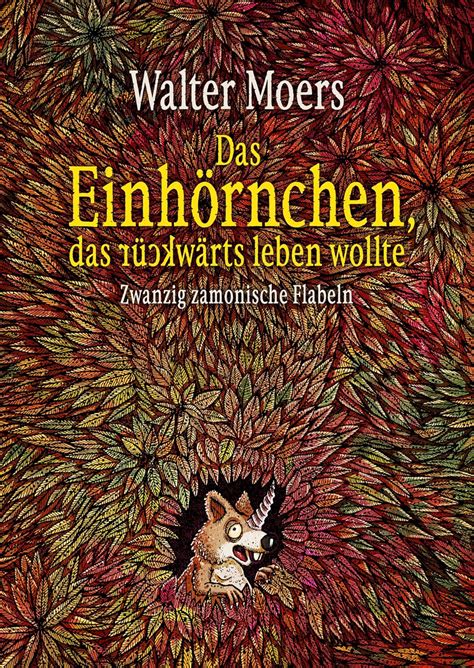
A collection of short stories written by Walter Moers.
My German may not be das Gelbe vom Ei (and my Latin definitely is not), but I still enjoyed the book. My favourite stories were "Die neun Dummwölfe und der Schlaufuchs" and "Der Werwolf, der ein Wiewolf sein wollte".
Die neun Dummwölfe und der Schlaufuchs
The title can be translated as "The nine Dumbwolves and the Slyfox". Apart from the description of the wolves, as stereotypical violent hooligans, and the fox, as a stereotypical decadent intellectual, what I found amusing was the solution the fox offered to the problem the wolves came to him with.
The story begins after the Dumbwolves have stolen ten sheep, and suddenly found themselves facing an incredibly difficult problem: how do you fairly divide ten sheep among 9 wolves?
To help solve this riddle, the undereducated protagonists decided to go to the fox, who has recently moved into a house on the outskirts of the forest. Who they found appeared less like a wise man, and more like a womaniser still drunk from yesterday's encounter with "friendly neighbourhood witches", but that did not deter them.
After they posed their question, and after the fox explained to them what he would charge them for the answer (he charges a percentage-based fee, and since the wolves are well-versed in percentage-based drinks, both sides agreed to proceed) the fox presented a truly solomonic solution.
And so said the Slyfox: "I propose the following solution: there are nine of you and keep one sheep - nine plus one equals ten. I am one and keep nine sheep, which also makes ten. You spit-roast the one sheep you kept, eat it together, and this way every one of you will get the same amount." He spread his arms wide and offered the wolves a half-smile: "So - what say you?"
Needless to say, the wolves were not amused and proceeded to beat the living shit out of the Slyfox, to rob his house, and, finally, to burn it down.
Der Werwolf, der ein Wiewolf sein wollte
The essence of the title is the wordplay between two "possible" meanings of the word "Werwolf". The first, obvious, one is "werewolf"; the second one, which is the pun, is "who-wolf", since the German question "wer?" asks "who?". So the title can be understood as "The Who-wolf who wanted to be a How-wolf?"
As can be easily guessed, the story is about a werewolf who is in the midst of an existential crisis, tortured by questions about life's very nature.
On his way home from school he meets a magical Little Rootsman who, as he explains to the Werewolf, is able to make even impossible wishes come true, as long as the Werewolf correctly answers the Little Rootsman's three questions. (In German, the Little Rootsman's name is Wurzmännchen, which is a compound word created from three smaller words: "Wurzel", which means "root"; "mann", which means "man"; and "chen" which is a suffix for cute or small things, kind of like the Japanese suffix -chan.)
After answering the first two questions correctly, and being amazed that they were a bit easy (as the Little Rootsman explains, no one said they will be difficult), the Werewolf fails to translate a long and complicated Latin sentence into proper German. Exasperatedly, he exclaims that he can't be expected to be able to do that, having only had basic Latin at school, but the Little Rootsman is not swayed by the Werewolf's pleas, replies with a simple "Well, tough luck!" and disappears into the forest.
What is the moral of the stories?
I do not think there is one, except maybe "life is sometimes absurd, and you can't do shit about it." Which, if you think about it, is actually a pretty good point.